Your cart is currently empty!

Pahwa Plastics Case
Important Judgements
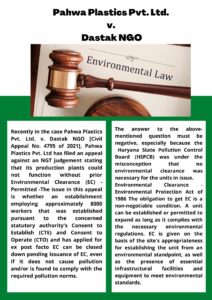
Recently in the case Pahwa Plastics Pvt. Ltd. v. Dastak NGO [Civil Appeal No. 4795 of 2021] , Pahwa Plastics Pvt. Ltd has filed an appeal against an NGT judgement stating that its production plants could not function without prior Environmental Clearance (EC) – Permitted – The issue in this appeal is whether an establishment employing approximately 8000 workers that was established pursuant to the concerned statutory authority’s Consent to Establish (CTE) and Consent to Operate (CTO) and has applied for ex post facto EC can be closed down pending issuance of EC, even if it does not cause pollution and/or is found to comply with the required pollution norms. The answer to the above-mentioned question must be negative, especially because the Haryana State Pollution Control Board (HSPCB) was under the misconception that no environmental clearance was necessary for the units in issue.
Environmental Clearance – Environmental Protection Act of 1986 The obligation to get EC is a non-negotiable condition. A unit can be established or permitted to expand as long as it complies with the necessary environmental regulations. EC is given on the basis of the site’s appropriateness for establishing the unit from an environmental standpoint, as well as the presence of essential infrastructural facilities and equipment to meet environmental standards. Pollution regulations must be carefully enforced in order to safeguard future generations and promote sustainable growth. Polluting industries must be NOT be permitted to function uncontrolled and destroy the environment under any circumstances.Ex post post facto
Environmental Clearance – The EPA, 1986 does not restrict Ex post facto Environmental Clearance – It should not be granted consistently, but only in extraordinary situations, taking all relevant environmental concerns into account. Ex post facto approval should be granted in accordance with law, in strict compliance with the applicable Rules, Regulations, and/or Notifications, where the negative consequences of denial of Ex post facto approval outweigh the negative consequences of regularisation of operations by grant of Ex post facto approval, and the establishment concerned otherwise conforms to the requisite pollution norms.
The aberrant enterprise may be punished by a severe penalty based on the ‘polluter pays’ concept, and the expense of environmental rehabilitation may be recovered from it. An enterprise that contributes to the country’s economy and provides employment should not be shut down just because of a technical infraction such as failing to get previous Environmental Clearance, regardless of whether the unit really pollutes the environment. .
Leave a Reply